Bullion
Lot GB-0418 Gold bar, 100 g, 999
- FromBullion dealer, PO/0229
- Rate₹12,850 a gram, ₹12,85,000
- GST3%, ₹38,550 input credit
- IssuedKarigars: 60.30 g and 5.10 g
- Balance34.60 g in the vault

Gold moves by the milligram, and so does every karigar’s balance.
Tell us how you runBullion
Karigar job
Counter sale
Branch transfer

Every piece tagged with its gross weight, net weight and stones, and priced on the day’s rate. Making charges on their own line.

Gold issued to karigars by weight and received back with the wastage agreed. What each karigar holds is always known.
Metal held by weight and purity in every location. Old gold bought in is kept apart until it is refined.
Pieces go for hallmarking and come back with their HUID recorded on the serial. Wholesale buyers are billed by weight.
The bill of materials carries the gold by weight, every stone and the karigar’s making charge, priced at the day’s rate. Point at a part to find its line.
 BoM: Solitaire ring, 22K, 4.82 g
ComponentQtyCost
OperationTimeCost
BoM: Jhumka pair, 22K, 8.40 gComponentQtyCost
OperationTimeCost
BoM: Pendant necklace, 22K, 8.10 gComponentQtyCost
OperationTimeCost
Follow one pair of bangles through Odoo, from the gold bought to the customer’s invoice.
Bullion is received by weight and purity, as its own lot.
 Purchase
 Inventory
 WH/IN/00229Done
Gold goes to the karigar as subcontracting. Odoo knows how much metal each one holds.
PurchaseInventory PO/0236Confirmed
The finished bangles come back weighed. Wastage is checked on the fine gold, against the agreed allowance.
Inventory Quality
 WH/IN/00241Done
The pair goes for hallmarking and comes back with its HUID, recorded on the lot.
Quality HM/0207Done
At the counter the price is built from the day’s rate, the weight and the making charge. Old gold taken in is set against the bill.
 Point of Sale
 POS/0912Paid
The GST invoice shows metal and making separately, with the HUID on the line. The old gold is a purchase in the same books.
 Accounting
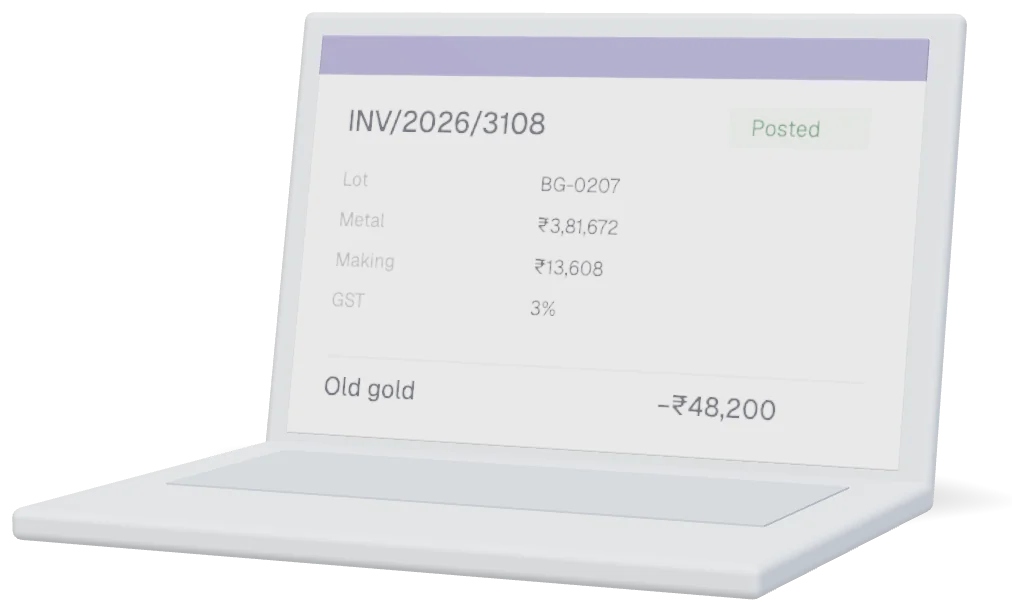 INV/2026/3108Posted
Karigars return the work, and the metal balance is settled on trust once a year.
Issue gold to karigars as subcontracting, by weight, with the agreed wastage.
When every gram out has a gram back or a reason, the balance is a report, not an argument.
Purchase
The day’s rate goes up on a board, and each counter applies it a little differently.
Set the day’s rate once and let every price follow it.
With some set-up, one rate drives every counter and the website. A rate keyed in per bill is where money leaks.
Point of Sale
The tag says 8.2 g, the scale says 8.0 g, and nobody knows which piece moved.
Give every piece a serial with its weights and stones.
The stock count becomes a scan, and a missing piece is found that day, not at the audit.
 Barcode
Old gold is taken in at a figure agreed on the spot and never checked against what refining returns.
Record old gold as a purchase, with its tested purity and weight.
Melting and refining losses then show per exchange, and the counter rate can follow the truth.
Purchase
Making is folded into one figure, so margin by design is invisible.
Put making charges on their own line on every bill.
Customers ask for it anyway, and it shows which designs and karigars pay.
Accounting
A customer wants a 12 g chain; the shop rings two branches to find one.
Keep every showroom’s stock in one Odoo, piece by piece.
Any counter can see a piece in another branch and move it the same day.
Inventory
Live in 8–14 weeks. Nothing switches off until your books agree.
Common in family-run showrooms. Tag registers and karigar books become records from the first day.
What moves across
Usually quick at the counter and weak everywhere else: karigars, branches and the books.
What moves across
For larger manufacturers and exporters. Metal accounts and designs come across; the workarounds don’t.
What moves across
Yes, with some set-up. Stock is held in grams and the day’s rate is set once; a small customisation builds each piece’s price from its weight, purity and making charge at the counter.
Yes. Each piece is a serial number, and its gross weight, net weight, stones and HUID are recorded on it with a few added fields.
As subcontracting. Gold is issued to the karigar by weight, finished work is received against the order, and what each karigar holds is visible at any time. Wastage allowances need some set-up.
Yes, with some set-up. Old gold is bought in by weight and tested purity, and its value is set against the customer’s bill, so both sides of the exchange are on record.
Yes, through Odoo’s Indian localisation: 3% GST on sales, e-invoices for B2B sales, and GSTR returns from the same books.
Not as standard. Instalments can be recorded as customer advances; a scheme with bonus months and maturity tracking is a customisation we’d scope with you.
Yes. Point of Sale and the Odoo website draw on the same stock, piece by piece, so a piece sold online shows as gone at the counter.
At cost, by weight, in every location. With some set-up a report at the day’s rate sits beside it, so you see book and market value together.
Yes. We’ve moved groups off SAP and other ERPs. Masters and open balances come across, you run one month-end side by side, and you switch when the numbers agree. Planning shows where Odoo fits as it is and where it needs building.
Question not here? WhatsApp us.
A senior consultant reads every note and replies personally.
Or call +91 79750 29997 or WhatsApp us