Machined part
Lot GR-2207 Spur gears, 40 teeth
- FromEN8 bar, heat H-4471, Peenya
- Hobbing42 min on WC-03, MO/0731
- HardenedJob work, heat-treater, Hosur
- Cost₹212 a gear, standard ₹188
- ToMotor SN-48120

What the job actually cost, machine by machine, not what the estimate said.
Tell us how you runMachined part
Assembly
Bought-in part
Export

Routings with set-up and run times on every machine. Each lot of parts traced back to the heat of bar it was cut from.
Sub-assemblies with their own bills of materials, built in order. A serial number on every unit, with its test results.

Customer schedules turned into manufacturing orders and purchase. Parts sent out for plating or heat treatment tracked as job work.
Packed against the sale order, crate by crate, with weights on the packing list. Export invoices without GST or under LUT, in any currency.
The bill of materials tells Odoo what to buy, what to machine and what each unit costs. Point at a part to find its line.
 BoM: Electric motor, 1.5 kW
ComponentQtyCost
OperationTimeCost
BoM: Helical gearbox, 5.5 kWComponentQtyCost
OperationTimeCost
BoM: Centrifugal pump set, 7.5 kWComponentQtyCost
OperationTimeCost
Follow one motor through Odoo. Every step writes to the same serial number, so its cost and its history are in one place.
The sale order creates the manufacturing orders. Bearings that will run short raise their own purchase.
 SalesManufacturing
 SO/2207Confirmed
Bearings are scanned in by lot and checked at the dock. A failed check never becomes stock.
 Inventory
 Quality
 WH/IN/00412Done
Operators start and finish each work order on a tablet. Parts are drawn by lot and time is booked as it happens.
Manufacturing Shop Floor
 MO/0744Done
The run test is a quality check on the serial number. A motor that fails goes to rework, not to the crate.
Quality QC/0217Done
Each crate is a package on the delivery, with the serials inside it. The e-way bill comes from the same record.
Inventory WH/OUT/00731Delivered
The GST invoice and its e-invoice come from the delivery. The serials are printed on it, for the warranty.
 Accounting
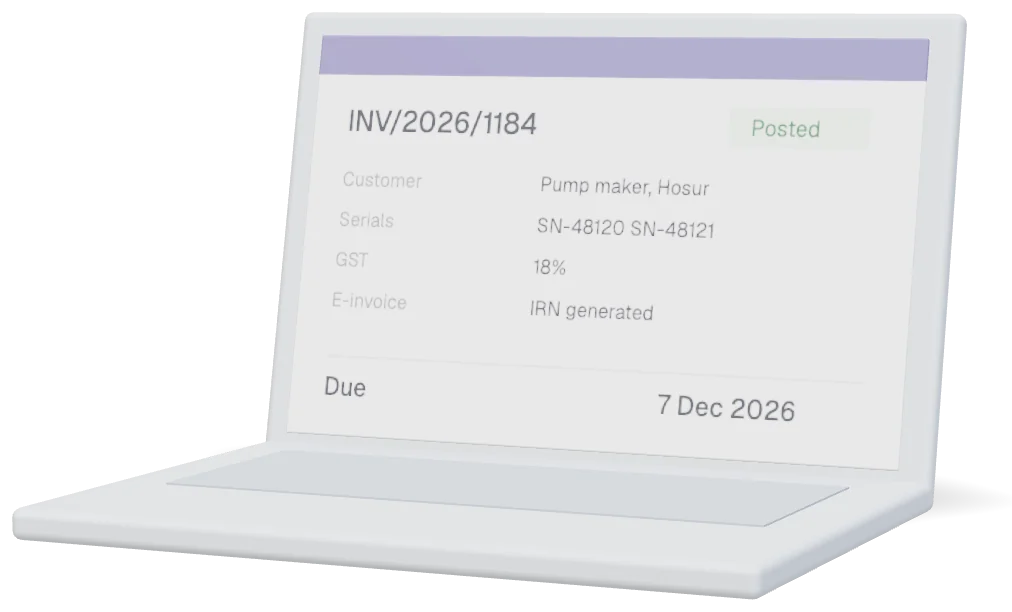 INV/2026/1184Posted
The quote uses a standard cost nobody has checked since the steel price moved.
Cost each manufacturing order on the material and time it actually used.
Compare actual against standard every month. The products losing money are rarely the ones anyone suspects.
Manufacturing
Parts go to the plater or the heat-treater on paper, and nobody knows what is still with them.
Run job work as subcontracting, with each vendor as a stock location.
Material at a vendor is still your stock. Once it is a location, you can count it.
 Purchase
A seal or a bearing runs out because the reorder level lives in the storekeeper’s head.
Put min and max reordering rules on every bought-in part.
Start with the fifty parts that stop the line, not all five thousand.
Inventory
Rejected parts are reworked quietly, so the scrap rate looks fine and the cost doesn’t.
Put quality checks on the work order and record scrap where it happens.
A failed check with a reason is the start of fixing it. A good part made twice is not a good part.
Quality
Ask where an order is and someone walks the floor to find out.
Put work orders on a tablet at each work centre.
When operators start and finish on the screen, the times are real and every order’s position is known.
Shop Floor
Engineering changed the design; the floor still builds the old one.
Keep one live bill of materials per product, with a version for every change.
PLM in Enterprise runs engineering changes properly. Even without it, one owner per BOM fixes most of this.
Manufacturing
Live in 8–14 weeks. Nothing switches off until your books agree.
Where most manufacturers we meet start. Bills of materials in Excel become live BOMs from the first day.
What moves across
The data comes across; the workarounds built around the old system don’t.
What moves across
Production in one tool, money in another, and nobody sure the two agree.
What moves across
Yes, as standard. Sub-assemblies have their own BOMs and routings, and can be built to order or from stock. Kits, by-products and variants of one product are handled too.
Yes. Subcontracting sends the components to the vendor and receives the finished part against its BOM, so the material at each vendor stays visible. The Indian job-work challan format and ITC-04 reporting need some set-up.
From the bill of materials and each work centre’s hourly rate. Every manufacturing order records what it actually consumed and how long it took, so you can compare the real cost with the standard.
Yes. The Shop Floor app runs on a tablet at each work centre: operators see their instructions, start and stop the job, record quantities and scrap, and complete quality checks. It is part of Odoo Enterprise.
Work centres carry their capacity and working hours, and work orders are planned against them. For most plants that is enough; a job shop with hundreds of interlocking operations may need a dedicated scheduler alongside.
Yes. Lots and serial numbers follow each part from the receipt through every manufacturing order to the delivery, and the traceability report shows the chain both ways.
Yes. The Maintenance app schedules preventive work by date or by usage, and breakdowns are logged against each machine. Its downtime blocks the work centre, so planning knows the machine is out.
Yes, through Odoo’s Indian localisation: GST on every invoice, e-invoices and e-way bills generated from the system, and GSTR returns from the same books.
Yes. We’ve moved groups off SAP and other ERPs. Masters and open balances come across, you run one month-end side by side, and you switch when the numbers agree. Planning shows where Odoo fits as it is and where it needs building.
Question not here? WhatsApp us.
A senior consultant reads every note and replies personally.
Or call +91 79750 29997 or WhatsApp us