Intercompany sale
SO/C01/0418 600 plastic crates
- SellerManufacturing company, Karnataka GSTIN
- BuyerTrading company, Tamil Nadu GSTIN
- MirrorPO/C02/0233, made on confirm
- GSTIGST 18%, ₹87,480, e-invoice
- Settled₹5,73,480, both sides at ₹0

Close the group’s books without a spreadsheet only one person understands.
Tell us how you runIntercompany sale
Recharge
Group close

The factory sells to its own distribution company at a transfer price. One order creates the other, so neither side types it twice.

A GSTIN in each state you trade from. Where they share one PAN, they are branches of one company, not separate books.

The property company charges rent to the operating ones every month. Each keeps its own books, and the group sees them together.

One accounts team works for every company from one login. Every entry carries the company it belongs to.
Follow one intercompany sale through Odoo. Each company keeps its own books, and both sides come from the same document, so they agree at year end.
The manufacturing company confirms a sale to its sister company at the agreed transfer price.
 Sales
 SO/C01/0418Confirmed
The purchase order appears in the trading company on its own. Nobody keys it in.
 Purchase
 PO/C02/0233Confirmed
Peenya ships with an e-way bill. Hosur receives against the mirrored order.
 Inventory
 C01/OUT/0791Done
Posting the invoice in one company creates the vendor bill in the other.
 Accounting
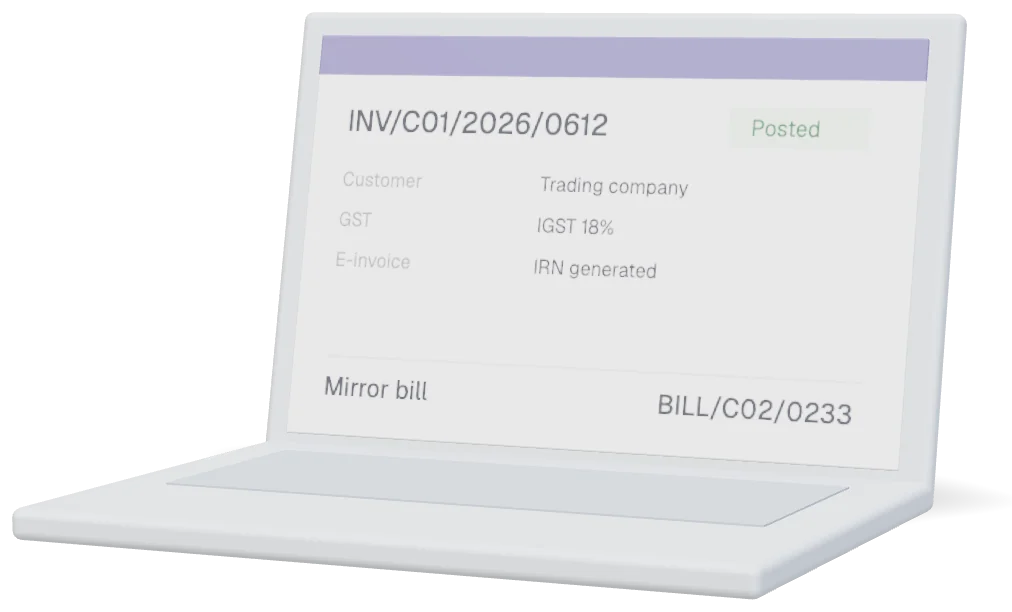 INV/C01/2026/0612Posted
The payment clears both sides. Intercompany balances are checked every month, not every March.
Accounting Intercompany balanceNov 2026
The group’s P&L runs across both companies. Intercompany sits on its own accounts, so it comes out in one step.
Accounting Dashboards
 Group P&L, Nov 2026
One company raises the invoice; the other keys in the bill a week later, with a different figure.
Switch on intercompany rules, so one document creates the other.
Two people typing the same transaction is where the mismatches start. Take one of them out.
Accounting
At year end one company says ₹12 lakh is owed; the other says ₹9.4 lakh.
Reconcile intercompany accounts every month, from the same documents.
A month’s difference takes an hour to find. A year’s takes the auditors a week.
Accounting
Each company’s trial balance exported, pasted and adjusted by hand every quarter.
Run group reports across the companies in one database, with intercompany on its own accounts.
A spreadsheet is fine for the last adjustments. It shouldn’t be where the numbers come from.
Dashboards
Sales says it’s out of stock while the other company’s warehouse has 300 on the shelf.
Let users see stock in the companies they’re allowed into, and move it with intercompany orders.
The stock belongs to one company, but the decision to sell it is usually the group’s.
Inventory
The holding company pays the rent and the accounts team, and the operating companies look more profitable than they are.
Recharge shared costs every month, split on an agreed basis, as intercompany invoices.
Profit by company only means something once each one carries its share of the costs.
Accounting
Each state GSTIN was set up as its own company, so one legal entity closes five sets of books.
Make GSTINs that share a PAN branches of one company; keep companies for separate legal entities.
Branches keep their own GSTIN and invoices but share the books. It is the most common set-up mistake we undo.
Accounting
Live in 8–14 weeks. Nothing switches off until your books agree.
Where most groups we meet start. Each company closes on its own, and the group is put together in Excel.
What moves across
The factory on SAP or an older ERP, the trading arm on Tally, the shops on a POS. They meet in a spreadsheet.
What moves across
Several databases, joined by exports. Brought into one, company by company.
What moves across
Yes, as standard. Each company has its own chart of accounts, journals, GSTIN and returns in one database, and users only see the companies they’re allowed into.
A company is a separate legal entity with its own books. A branch shares its parent’s books but has its own GSTIN, address and invoice numbering, which suits one PAN registered in several states.
Yes, in Odoo Enterprise, once intercompany transactions are switched on. Confirming the sale order creates the purchase order in the other company, and posting the invoice creates the vendor bill.
Partly. The balance sheet and P&L can run across several companies at once. Taking out intercompany balances needs some set-up: we keep them on their own accounts so they come out in one step. Consolidation with minority interests and ownership percentages is still done outside Odoo, or with customisation.
Products and contacts can be shared across companies or kept to one. Each company owns its warehouses, and stock moves between companies through intercompany orders, so both sets of books see it.
Yes. Each company has its own currency, so a Dubai or Singapore company keeps its books in dirhams or dollars, and reports across companies convert them at the rates in the system.
No. Odoo is priced per user, not per company. Running several companies does need Odoo’s Custom plan, or Odoo.sh or your own server, and we’d price that with you before you commit.
Yes. One user can be allowed into several companies, switch between them or work in more than one at once, and every entry is stamped with the company it belongs to.
Yes. We’ve moved groups off SAP and other ERPs. Masters and open balances come across, you run one month-end side by side, and you switch when the numbers agree. Planning shows where Odoo fits as it is and where it needs building.
Question not here? WhatsApp us.
A senior consultant reads every note and replies personally.
Or call +91 79750 29997 or WhatsApp us