Villa
Unit V-14 Villa, Sarjapur Road
- Price₹1,42,00,000, construction-linked
- Booked₹10,00,000, unit blocked for the buyer
- DemandThird slab, 15%, ₹21,30,000 + 5% GST
- TDS1%, ₹21,300, deducted by the buyer
- Paid₹22,15,200, by the home-loan bank

Who booked which unit, which stage is billed and who still hasn’t paid.
Tell us how you runVilla
Apartment
Possession
Every flat one record with one status: available, blocked, booked, sold. Demands go out by construction stage.

Site visits and follow-ups tracked from the first call. Each buyer’s payments sit against their own unit.
Leases with their rent, escalation dates and CAM charges. Rent invoices with GST go out on the same day every month.

Many owners, many tenants, one set of books. Deposits held against each tenant and returned against the same account.
Follow one villa through Odoo. The enquiry, the booking, the demands and the handover all hang off unit V-14, so the buyer’s account is never rebuilt from files.
The enquiry is logged with its source. The follow-up is booked before the visitor leaves the site.
 CRM
 Villa enquirySite visit
The booking blocks the unit for this buyer. Nobody else can sell it this weekend.
 Sales
 SO/0214Confirmed
The allotment letter is signed online and filed against the unit.
 Sign
 Documents
 Allotment letter, V-14Signed
When the stage is certified, the demand goes out the same day, with GST.
 Project
 Accounting
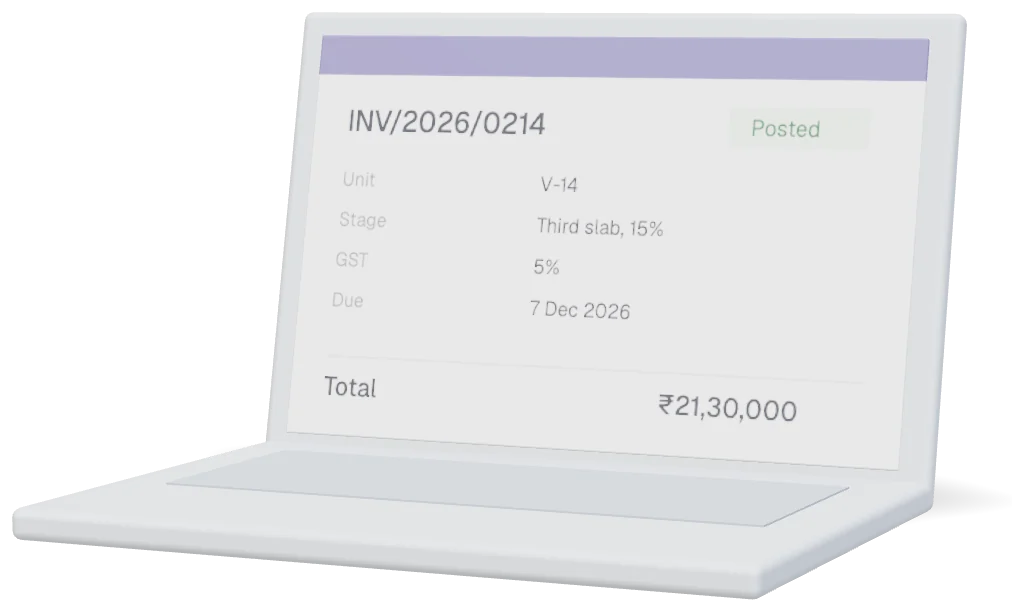 INV/2026/0214Posted
The bank’s disbursement and the buyer’s TDS are both posted against the demand.
Accounting Payment for INV/2026/0214Paid
Snags are logged and closed before the keys change hands.
 Helpdesk
 Handover V-14Done
Walk-ins written in a register, called once, then forgotten.
Log every enquiry in CRM with its source, and book the follow-up before the visitor leaves.
The marketing spend already bought the visit. Losing it to a missed call is the most expensive leak in the business.
CRM
Two sales staff blocked the same flat for two buyers on the same weekend.
Keep each unit as one record with one status, blocked the moment a booking is entered.
A whiteboard can’t refuse a second booking. A record can.
Sales
The slab was done in October; the demand letters went out in December.
Raise stage demands from the project, the day the stage is certified.
Every week of delay is construction funded from your loan instead of the buyer’s payment.
Project
Thirty tenants, rent due on different days, followed up from a notebook.
Bill rent as recurring invoices, with automatic reminders and one list of who is overdue.
Most late rent isn’t refusal. It’s nobody asking on time.
Accounting
Security deposits taken years ago; at move-out nobody agrees what was paid.
Hold each deposit as a liability on the tenant’s account, and return it against the same account.
A deposit is the tenant’s money. The books should say so, by tenant, not as one lump.
Accounting
The lease says 5% a year; the rent hasn’t moved in three.
Put the escalation date on the lease contract, with a reminder to reprice the recurring invoice.
Three missed escalations on a commercial lease is real money, and it can’t be backdated.
Sales
Live in 8–14 weeks. Nothing switches off until your books agree.
Bookings in Excel, collections in Tally, unit status on a whiteboard in the sales office.
What moves across
Strong on bookings or on accounts, rarely on both. Units, buyers and money move onto one record.
What moves across
Leases in files, rent in a notebook, deposits in somebody’s memory.
What moves across
Not as a standard app. We build on CRM, Sales, Subscriptions, Accounting and Documents, with units set up as their own records. For most developers and landlords that covers the work; some of it, such as stage-wise payment plans, needs customisation.
Yes, with some set-up. Each unit has a status (available, blocked, booked, sold), and a board by tower and floor shows them at a glance.
Yes, with some set-up. The payment plan sits on the sale as milestones; when a stage is reached, the demand is invoiced with GST and the buyer’s ledger updates.
Through Subscriptions: one recurring invoice per lease, monthly or quarterly, on the day you choose, with GST where it applies and reminders when it is late.
Yes. Deposits are held on a liability account by tenant; deductions at move-out are posted against it and the balance refunded.
Buyers deduct 1% TDS on property above ₹50 lakh. Odoo records it against the demand, so the buyer’s balance is right and you can match it to your TDS credits.
Yes, through the customer portal: demands, invoices, payments and documents, without calling the office.
Each project can have its own bank journal and analytic account, so collections into the designated account and project-wise costs come straight from the books. The RERA filings themselves are prepared from those reports.
Yes. We’ve moved groups off SAP and other ERPs. Masters and open balances come across, you run one month-end side by side, and you switch when the numbers agree. Planning shows where Odoo fits as it is and where it needs building.
Question not here? WhatsApp us.
A senior consultant reads every note and replies personally.
Or call +91 79750 29997 or WhatsApp us